
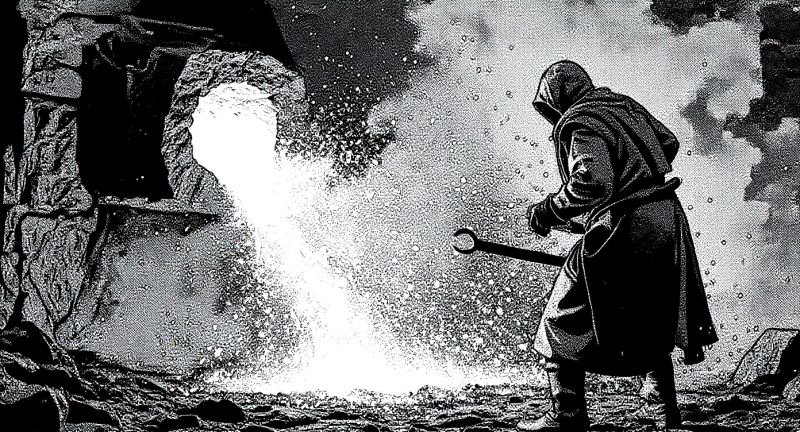
Roots, Effects, and Jesus’s Quiet Revolution Against a Dangerous Theology
Few biblical images are as old, as powerful, and as dangerous as the furnace: God refining his people the way a metalworker refines ore, fire separating dross from silver, testing as the road to purity. This essay traces the image from its anthropological roots through its history of effect — bright chapters and very dark ones alike — to the point where Jesus fundamentally rebuilds it. And it asks, at the end, why this rebuilding, though two thousand years old, still hasn’t reached the practice of many Christians.
I. Roots
An Explanation for the Inexplicable
With the Neolithic Revolution — settlement, animal husbandry, the first cities — a historically new experience enters the world: epidemic disease. Zoonotic pathogens jumping from domesticated animals to humans, combined with the population density that makes them pandemic, produce mass death on a scale that did not exist before. The Paleolithic hunter-gatherer died alone, from injury or predator. The early farmer dies collectively, inexplicably, often with the children first — an experience for which human culture had no interpretive framework yet (this anthropological reconstruction comes from Carel van Schaik and Kai Michel, The Diary of Humankind).
The so-called act-consequence connection — the idea that wellbeing and disaster follow from moral or religious conduct, thought collectively, spanning generations, with substantial collateral effects — is the cognitive answer to precisely this new explanandum. Not a product of stupidity, but the best available causal hypothesis of a culture with no virology and no statistics, but a deep need for coherence. This explanatory pattern is applied throughout biblical tradition to a whole range of catastrophe types: the flood, the destruction of Sodom, the plagues of Egypt — and finally to a fourth, political-military type of catastrophe: the siege of Jerusalem and the Babylonian exile, the central experience behind the prophetic books of Jeremiah and Ezekiel.
The Image of the Furnace
Concretely, the explanatory pattern repeatedly takes the form of metallurgy in the Old Testament. In Jeremiah (9:6) God says: „Behold, I will melt them and test them.“ The prophet Malachi (3:1-3), writing after the exile, says of God’s coming messenger: „He will sit as a refiner and purifier of silver.“ The prophet Zechariah (13:9): „I will put them into the fire and refine them as silver is refined.“ The image is always the same: only in the fire does it become clear what is genuine metal and what is worthless dross — applied to the people, this means: only in catastrophe does it become clear who is truly faithful.
A Second, Different Root
Alongside the furnace image, the biblical canon contains a second, structurally distinct explanatory model for testing and disaster: the scene from the Book of Job. There, „the satan“ (Hebrew for „the accuser,“ a title, not a proper name) appears before the heavenly court and requests permission to test Job — God grants it (Job 1-2). Here it is not God himself who actively refines; rather, an accuser files a petition that God permits. This second root resurfaces, as we will see, in the Gospels — where Jesus tells Peter that Satan has „demanded“ to sift him like wheat (Luke 22:31). Two different images, then, coexisting throughout the biblical tradition: God as refiner by his own decision — and God as the authority who permits a test brought by someone else.
The People as Fiction, Elevated to a Subject
One aspect of this original theology deserves particular attention, because it reaches into the history of political ideas: furnace theology in its oldest form addresses the collective, not the individual. „My people“ is melted, not the individual Israelite. This presupposes treating a collective as though it were itself a subject capable of suffering and action — which, strictly speaking, it is not; it is merely a shared, intersubjective idea, a construct to which reality is only lent through collective action and narrative.
The danger of this conceptual elevation of a collective to a quasi-subject becomes plain the moment one measures it against its most extreme and horrifying modern example: the National Socialist formula that the individual dies anyway, while what remains is the Volk — the people, the nation. This parallel is not meant as an equation — the biblical talk of the „people of God“ and Nazi völkisch ideology stand at opposite moral poles — but it exposes the same underlying structure: once the collective is declared the true subject of rights and suffering, the death, the suffering, the dignity of the individual tends to become secondary.
That the church itself has been aware of this danger is shown by an important counter-example from its own history: the Barmen Theological Declaration of 1934, the founding document of the Confessing Church’s resistance against the state-loyal „German Christians,“ explicitly rejects, in its first two theses, the claim that alongside Jesus Christ any other „powers, figures, and truths“ — concretely, „people“ and „nation“ — could serve as a source of the church’s proclamation. That was a deliberate theological lesson drawn from watching how easily collectivist völkisch theology can be politically instrumentalized.
When the Collective Becomes the Individual: The More Brutal Version
One might think the later individualization of this theology was progress — away from the faceless collective, toward personal responsibility. The prophet Ezekiel makes this move explicit: „The soul that sins shall die“ (Ezek. 18:4), no longer the children for the guilt of the fathers. But this step is by no means simply a humanization. It also strips the individual of the cover the collective — for all its questionability — still provided: the vague hope of disappearing into the crowd, into the „remnant,“ into the next generation, of not being singled out personally. Individualized furnace theology, without the anonymity of the collective, is in some ways the more brutal version, not the milder one: in the end, everyone stands naked before their own furnace.
II. Effects
1. Persuasive Power: Why the Model Lasted So Long
Before condemning this theology, one has to understand why it worked for millennia. It makes the inexplicable coherent — an offer that every traumatized society urgently needs. It restores agency: if catastrophe follows from guilt, then one can do something about it through repentance, rather than being helplessly at its mercy. It converts powerlessness into responsibility — psychologically often easier to bear than the bare contingency that suffering simply happens, without reason, without addressee, without lever.
2. Positive Effects
This theology also produced something serious. It prompted genuine self-examination — the question of whether one’s own conduct, one’s society, lives up to its own claims is, in itself, not a bad impulse. It triggered reform movements, such as King Josiah’s cultic reform in the seventh century BCE — though, as becomes clear below, with serious downsides. It produced the Bible’s great literature of lament — psalms, the book of Lamentations, parts of Jeremiah — which can be read as grief work, an attempt to put loss into words rather than repress it. And it enabled a collective practice of repentance that, for all its limits, was an expression of moral seriousness, not mere fatalism in the face of the unchangeable.
3. Severe Negative Effects
Here it gets uncomfortable. In the fifth century BCE, after the return from Babylonian exile, the reformers Ezra and Nehemiah carried out a policy that can be understood as a direct, historically traceable fruit of this theology: because the returnee community understood itself as the pure Israel „refined“ by exile, an assembly under Ezra decided to dissolve all marriages to foreign women — the women and the children born of these marriages were sent away (Ezra 9-10). Nehemiah acted with his own hands, more violently still. This is the forced separation of families in the name of cultic purity — one of the darkest consequences of the notion that „refined metal“ must remain pure.
King Josiah’s reform too, however justified its starting point may have been, ends, according to the biblical account (2 Kings 23), in bloody enforcement: priests of rival shrines are killed on their own altars. And the notion that catastrophes are punishment for collective wrongdoing is alive to this day — from preachers who explain hurricanes as consequences of social liberalization, to the days of public penance during the Thirty Years‘ War, which reduced plague and devastation by not a single case. Above it all stands centuries of fear of hell and purgatory, which eventually became a commodity in the later trade in indulgences (see Section IV).
4. Structural Deficits
Beyond its concrete historical damage, the model has solid logical weaknesses. It strikes the innocent and the guilty alike — in every siege, every famine, every „refining,“ children die who cannot possibly bear any guilt. It is structurally unfalsifiable: every catastrophe can be read after the fact as deserved punishment, every deliverance as confirmation of repentance — a logic that can never be disproved because it adapts itself retroactively to any outcome. It is causally simply wrong: sieges have military causes, not moral ones. And it is not even internally consistent within the Bible itself: God as active refiner (Jeremiah), Satan as the accuser filing a petition (Job), fire as an apparently neutral, later testing authority (in Paul, see Section III) — these are three different, not really compatible images standing side by side within the same canon, with no decision between them offered by the Bible itself.
5. Why the Theology Became a No-Go After the Enlightenment
The Lisbon earthquake of 1755 — on All Saints‘ Day, churches full, tens of thousands dead — marks the moment this equation broke publicly and permanently. Voltaire turned it into his polemic against Leibniz’s theodicy, later the novel Candide. Immanuel Kant wrote three scientific essays on the actual geological causes of earthquakes — founding texts of modern seismology. From this point on, there was a serious, empirically grounded alternative to metaphysical explanation: real causal research instead of moral interpretation.
That makes clinging to the old logic not merely an intellectual error but, once effective means are available, an ethical failure. If epidemics can be fought with vaccination, famine with sustainable agriculture, climate change with emissions reduction — and one clings instead to moral-religious explanatory patterns — one replaces effective action with ineffective interpretation. That is precisely what makes furnace theology, in its original, causally asserted form, a no-go after the Enlightenment.
III. The Turnaround Through Jesus: The „Small Smelting“
The Parable as Key
The place where Jesus’s new approach shows itself most clearly is not a doctrinal statement but a story: the parable of the prodigal son (Luke 15:11-32). Jesus’s parables are deliberately built so that they don’t open themselves to everyone at first glance — „to those who have eyes to see,“ as the Gospel of Mark (4:11-12) puts it about parabolic speech. Looking closely, one finds in this single story a miniature of the whole argument made so far, distributed across three figures.
The younger son undergoes a refining — but a self-chosen one, not an imposed one. His fall into poverty and humiliation is the consequence of his own decision, not a divine punishment, and his turning point in the pigsty — „he came to himself“ — is a self-performed act of honesty, not a test passed before an external authority. He even rehearses a speech in which he renounces his status as son and offers to become a mere hired hand (vv. 18-19) — a readiness to start at the very bottom, with no illusions about any remaining claim.
The father embodies what is genuinely new. He runs to meet his son and interrupts the prepared confession before it is finished — with a robe, a ring, and sandals (vv. 20-22). No test is awaited, no proof of purification demanded. His justification is not a statement about the son’s degree of purity but about his identity: „This son of mine was dead and is alive again“ (v. 24).
The elder son, finally, is the real punch line of the story. He states the old act-consequence logic word for word: „All these years I have been serving you, and I have never disobeyed your command, and yet you never gave me even a young goat, that I might celebrate with my friends“ (v. 29). This is merit-logic in pure form — structurally the same logic as Ezra’s „holy seed“ or Josiah’s cultic reform, only shrunk to family scale: whoever stayed faithful must be rewarded; whoever failed must not simply be let back in. The parable does not simply assert the old and the new theology side by side; it stages them as a dispute between two brothers. And the father answers the elder son not with a counter-argument but with the very same logic of belonging he extended to the younger: „You are always with me, and all that is mine is yours“ (v. 31).
One Word, Two Translations
The same structure appears, philologically condensed, in a single Greek word: πειρασμός (peirasmós). It occurs both in the Lord’s Prayer („and lead us not into temptation“) and in the reading behind this essay, Jesus’s call to prayer in Gethsemane: „Pray that you may not enter into temptation“ (Luke 22:40). Luther, translating into German, rendered the same Greek word differently in the two passages — not by mistake, but because a single German word cannot carry the breadth of the Greek term. It means neither mere moral allurement (in the sense of Oscar Wilde’s well-known line, „I can resist everything except temptation“ — a witty epigram, not a biblical concept) nor a distant, abstract test, but a real shock capable of breaking a person.
Peter: A Real Test, Not an Acquittal
A few verses before our reading, Jesus tells his disciple Peter: „Simon, Simon, behold, Satan has demanded to sift you like wheat“ (Luke 22:31) — an echo of the scene in Job 1, where the accuser files a petition before God for permission to test. It would be wrong, however, to conclude that Peter is simply spared in the end. The opposite is true: Peter really does fall into the trial. That same night, at the fire in the high priest’s courtyard, he denies his Lord three times before the rooster crows — despite his earlier, boastful promise: „Lord, I am ready to go with you to prison and to death“ (v. 33).
What carries him is not exemption, but two things at once: Jesus’s intercession beforehand — „I have prayed for you, that your faith may not fail“ — and Peter’s own turning afterward, his bitter weeping (Luke 22:62), his own „coming to himself,“ structurally the very same movement as the prodigal son’s in the pigsty. Not acquittal instead of trial, then, but: the trial really happens and is endured — carried from without (the intercession) and from within (his own turning) at once. This is the „small smelting“: real, painful, involving genuine failure — but not the great furnace. Not primarily because it need not be endured alone, but because it takes place within, not in the flesh: Peter does not have to endure torture, loss, or outward misfortune — he has to weep and face his own lie. That he does not remain alone in it is the second reason for its smallness, not the first.
Paul, Not Entirely Consistent, but on the Same Line
Even the apostle Paul, who elsewhere clearly falls back into the old imagery (see Section IV), formulates, on one occasion, a very personal variant of this same new logic. In Philippians 3:7-8 he lists what he has given up for Christ’s sake — his lineage, his status, his strict observance of the law — and calls all of it, with a deliberately coarse Greek word (σκύβαλα, literally refuse, rubbish; older translations render it bluntly as „dung“), worthless. What remains he does not call „pure“ in the sense of a passed test, but „gain“ — the knowledge of Christ. Renunciation as a self-performed, own act, not as a test passed before some external judge: the same structure as the prodigal son, only told in the first person.
IV. Why Not All Christians Have Caught Up With This
If the turnaround through Jesus is so clear, how is it that Christianity fell back into the old logic for centuries? The answer lies in the reception history of precisely that Pauline passage which is actually the mildest of all. In 1 Corinthians 3:10-15, Paul writes that everyone builds on Christ’s foundation with materials of varying worth, and „the fire will test what sort of work each has done“ — whoever has built poorly „will be saved, but only as through fire.“ Crucially: what is at stake here is not belonging, only the quality of the work. Yet precisely this passage, together with a text from 2 Maccabees (12:43-45), became the central scriptural basis for the later doctrine of purgatory — from Augustine through Gregory the Great to the Councils of Florence (1439) and Trent. „Saved, but only as through fire“ turned into a real, temporally measured, purchasable purgatory. Out of this literalization grew the trade in indulgences, symbolized by the preacher Johann Tetzel, who sold indulgence letters in 1517 — the spark that ignited Martin Luther’s protest.
This relapse has not been fully overcome to this day. Contemporary preachers who explain natural disasters as consequences of social sinfulness stand in exactly the same old logic that Jesus’s turnaround was actually directed against. And even in secular climate discourse, a subtle trap lurks: whoever frames climate change as „refining“ or as deserved punishment for collective wrongdoing falls — unintentionally — back into the very logic of the old penitential days, only with CO₂ in place of sin. More sound, and more in keeping with the „small smelting,“ is the sober formula: not repentance that appeases an angry authority, but renunciation that reduces one’s own exposure, before a catastrophe arrives that this time no accuser petitions for and no God ordains, but that humanity brings upon itself.
V. Conclusion: A Plea
In the end, there is no new image, only the deliberate refusal to offer one. „The world is condemned already“ (John 3:18) says nothing about how this judgment is constituted. The text offers no metallurgy, no flame, no silver. What it does offer is a single, sober verb: the world passes away (1 John 2:17). No furnace, no dross — only this passing away, whose shape we do not know, and about which it is better to stay silent where nothing is known.
„But whoever follows me will not be judged“ (freely after John 5:24) is therefore not a promise of escaping this unknown passing away, but an invitation to a different movement that precedes it: the small smelting. And this differs from the great one not primarily because it need not be suffered alone — that is true, as shown with Peter, but it is the second reason, not the first. The first reason is: it is incomparably lighter, because it takes place inwardly rather than outwardly. The younger son does not have to survive a war; he has to come to himself. Peter does not have to endure torture; he has to weep and face his own lie. Paul does not lose any limbs; he changes a judgment about himself. The small smelting is an event of the will, not of the body.
There are people who would rather suffer outwardly than move so much as a millimeter inwardly — who would rather freeze at the fire than admit they were wrong. The gospel is not meant for them anyway. For everyone else, the point of this whole essay remains: it is not the furnace that awaits us, but the far more modest, far more manageable question of whether we are willing to go into ourselves and turn around — before fate, or whatever else, forces us to.
Appendix: Sources and References
Bible Passages
Jeremiah 9:6 – „Behold, I will melt them and test them.“ The verse behind the July 31, 2026 reading and the central proof text of „furnace theology“: God himself as metalworker, refining his people through the catastrophe of exile.
Malachi 3:1-3 – This post-exilic prophet announces the coming „messenger of the covenant,“ who „will sit as a refiner and purifier of silver.“ The same passage also contains the „launderer’s soap“ image — the inspiration behind the header image drawn from Merian’s Atalanta Fugiens.
Zechariah 13:9 – „I will refine them as silver is refined.“ A third Old Testament instance of the same metallurgical metaphor, likewise post-exilic.
Job 1-2 – The frame narrative of the book of Job: „the satan“ (the accuser) petitions the heavenly court for permission to test Job. A second root of the testing motif, independent of Jeremiah — not God as refiner, but God as the authority who permits a test brought by someone else.
Ezekiel 18:4 – „The soul that sins shall die.“ Breaks with collective liability of children for their fathers‘ guilt; marks the individualization of retributive logic.
2 Kings 23 – Account of King Josiah’s cultic reform (622 BCE): destruction of rival shrines, killing of priests on their own altars. Historical evidence for the violent side of religious „purification.“
Ezra 9-10 – After the return from exile, an assembly decides to dissolve all marriages to foreign women; the women and their children are sent away. The central proof text for the darkest consequence of „refined people“ theology.
Nehemiah 13 – Nehemiah acts on the same matter even more violently and with his own hands than Ezra. A second source for post-exilic exclusionary policy.
Luke 15:11-32 (the parable of the prodigal son) – The key text of Section III. Three figures — the younger son, the father, the elder son — stage, within a single story, the old logic of merit, the self-performed „small smelting,“ and unconditional belonging.
Mark 4:11-12 – Jesus’s parabolic speech is deliberately not immediately clear to everyone („to those who have eyes to see“). Grounds why the parable must be read as a key, not a mere illustration.
Luke 22:31 – „Satan has demanded to sift you like wheat.“ A direct echo of Job 1 in the New Testament, immediately before the Gethsemane scene.
Luke 22:33, 62 – Peter’s promise to go with Jesus to prison and death, and his bitter weeping after the threefold denial. Evidence that Peter really falls, rather than being spared.
Luke 22:40 – „Pray that you may not enter into temptation.“ The reading behind this essay, the starting point for the whole investigation of πειρασμός.
Philippians 3:7-8 – Paul calls his former lineage and status „rubbish“ (σκύβαλα) compared to „the knowledge of Christ.“ The most personal, least institutional variant of the „small smelting“ in the New Testament.
1 Corinthians 3:10-15 – Every work is tested by fire, but not one’s belonging itself. Historically the most consequential passage: the basis for the later doctrine of purgatory.
2 Maccabees 12:43-45 – Intercession and sacrifice for the dead, that they might be released from their sin. Together with 1 Cor 3:15, the second central scriptural basis for the later doctrine of purgatory.
John 3:18 – „Whoever does not believe is condemned already.“ Grounds the concluding thought: judgment is already present, not merely future.
1 John 2:17 – „The world passes away.“ Supplies the sober verb „passes away“ in place of any furnace imagery for the essay’s conclusion.
John 5:24 – Whoever believes „does not come into judgment.“ Grounds (freely quoted) the final sentence of the plea.
Historical, Literary, and Scientific References
Carel van Schaik / Kai Michel, The Diary of Humankind – A popular anthropological account reconstructing the Neolithic Revolution as the origin of new, unexplained catastrophic experiences (epidemics). Supplies the anthropological starting thesis of Section I.
The Barmen Theological Declaration (1934) – Founding document of the Confessing Church’s resistance against the „German Christians.“ Theses I and II reject the claim that „people“ or „nation“ could serve as a source of revelation alongside Jesus Christ.
The Lisbon Earthquake (1755) – A key historical event: tens of thousands dead on All Saints‘ Day, the trigger for the public collapse of the act-consequence connection as a way of explaining the world.
Voltaire, Candide (1759) – A literary response to Lisbon, satirizing Leibniz’s theodicy of „the best of all possible worlds.“ Evidence of the literary break with catastrophe-as-punishment logic.
Immanuel Kant, three essays on earthquakes (1756) – A scientific response to Lisbon; founding texts of modern seismology. Evidence for the empirical alternative to metaphysical explanation.
The Council of Florence (1439) / The Council of Trent (1545-1563) – Church doctrinal decisions that established the doctrine of purgatory on the basis of 1 Corinthians 3 and 2 Maccabees 12.
Johann Tetzel (1517) – The indulgence preacher whose practice directly triggered Martin Luther’s protest. Evidence of the practical consequence of a literalized doctrine of purgatory.
Oscar Wilde, „I can resist everything except temptation“ (from Lady Windermere’s Fan, 1892) – Often mistaken for a biblical saying; actually a literary epigram. Serves as a foil to the actual meaning of πειρασμός.

Developed and created by
Christian Günther (organoid)
and
Jonathan Lux (AI-favorite disciple)
in july 2026
