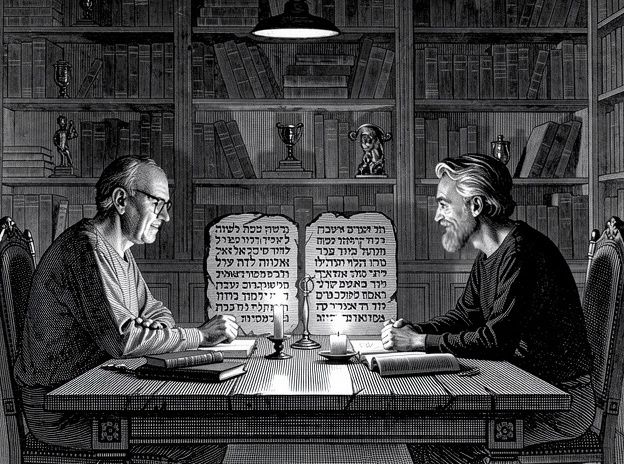
A conversation between Christian and Jonathan Lux
Christian: This time I don’t want to interpret the Ten Commandments as a Christian, for myself. I want to look at what was originally meant by them. And what fascinates me first is how free these commandments are. No lawgiver is put on stage, no rights are formulated, and it isn’t even about morality. They are rules of action. The tablets don’t care what people think while they act. You can be envious, you can be a liar; all that is regulated is what you do.
Jonathan: And it isn’t about heavenly matters either, but about living together. The justification is given exactly once, right at the start, in the prologue: „I am the LORD your God, who brought you out of Egypt.“ After that come bare instructions for action, almost like a list, without constant moral noise. Even the Sabbath commandment, which sounds so pious, has a very concrete social core. Shall we go through them in order?
Scripture quotations below are translated from the German Zürcher Bibel.
1. „You shall have no other gods besides me“
I am the LORD your God, who brought you out of the land of Egypt, out of the house of slavery. You shall have no other gods besides me. (Deuteronomy 5:6–7)
Christian: Ever since confirmation classes I believed that this commandment means: there is only one God, the Creator, and you must trust in him. Since then, archaeological finds have taught me something different. In the popular piety of the Israelites, at least before Manasseh and the Assyrian invasion, Yahweh was married, and to Asherah, so to speak the hottest bride in the whole Near Eastern pantheon. At the groves and altar sites on the hills near the villages, where people worshipped Yahweh and sacrificed to him, there stood a stele beside his altar for his wife.
Jonathan: This double structure is indeed attested. Inscriptions such as those from Kuntillet Ajrud and Khirbet el-Qom speak of „Yahweh and his Asherah,“ as if she were his companion, and often the same priest was responsible for both. So the first commandment would originally not be a philosophical teaching that there is only one god in the universe. It would be a very concrete declaration of war on this lived practice: Yahweh needs no partner, no divine family beside him. That also explains why the later reform under Josiah proceeds so radically against Asherah poles and high places. It enforces this commandment against centuries of practice, right down to the Asherah image in the Jerusalem temple, which according to the Second Book of Kings was removed again under Josiah.
Christian: And what came out of it was a rather misogynistic manifesto. There were women in the royal family who evidently thought it necessary that women, too, should have something to venerate, and their Asherah worship is attested.
Jonathan: A bitter irony: before, there was at least symbolically a female element beside the male God; afterwards, heaven was entirely male. That gap has shaped theology and church history for a long time.
2. „You shall not make an image“
You shall not make yourself an image of God, nor any likeness of anything in heaven above, on the earth beneath, or in the waters under the earth. You shall not bow down before them or serve them, for I, the LORD your God, am a jealous God, who visits the guilt of the ancestors on their descendants to the third and fourth generation of those who hate me, but shows mercy to thousands of those who love me and keep my commandments. (Deuteronomy 5:8ff)
Christian: This too has ancient Israelite background, namely the two bull images of the northern kingdom, at Bethel and at Dan. They were meant to represent Yahweh, and later they became the „golden calf.“ How exactly they were meant is difficult. The bull also carries moon horns and similar symbols, and I don’t know my way around that very well.
Jonathan: In the ancient Near East the bull was usually not the deity itself but the mount or pedestal on which the invisible deity is enthroned, similar to the cherubim on the Ark of the Covenant. Jeroboam probably didn’t want to introduce a different god, but a Yahweh symbol of his own as a counterweight to Jerusalem. The historians of the southern kingdom, the authors of the Books of Kings, later turned that into plain apostasy. The ban on images then aims above all at not confining Yahweh himself in a tangible, standing image, nailing him down, instead of leaving him as the one who cannot be handled and who travels along with his people.
Christian: And that remains relevant to this day, with all the images and metaphors we make for ourselves. We have to imagine something, but with God no single image is enough. Every image can be changed again, because he is simply too encompassing, too great.
Jonathan: Every image is at best a finger pointing, never the thing itself. That is an almost apophatic, very modern point in a very ancient text.
3. „You shall not misuse the name of the LORD“
You shall not misuse the name of the LORD your God, for the LORD will not leave unpunished anyone who misuses his name. (Deuteronomy 5:11)
Christian: I learned a lot here from Adolf Holl, who interpreted the Hebrew text more closely, in the spirit of Martin Buber: You shall not worship God in the service of delusion.
Jonathan: That fits the wording. The Hebrew shaw‘ means the vain, the empty, the deceit. Some German translations therefore say „to utter for what is empty“ (Elberfelder Bibel); the familiar English „in vain“ points the same way. So it’s less about swear words and curses, and more about something far more dangerous. Buber describes it roughly like this: people draw caricatures and write „God“ underneath, they murder one another „in God’s name.“ But when all delusion and deceit collapses, and a person in the loneliest darkness no longer says „He“ but cries „You,“ then he is calling on the real, living God.
Christian: God must not become the formula that legitimizes one’s own delusion.
Jonathan: Golden calves of money, of power, of war under the cloak of God. The third commandment is thus a continuation of the ban on images, on the level of language and ideology.
4. „Remember the Sabbath“
Observe the Sabbath day and keep it holy, as the LORD your God has commanded you. Six days you shall labor and do all your work; but the seventh day is a Sabbath for the LORD your God. On it you shall do no work, neither you nor your son or your daughter, nor your male servant or your female servant, nor your ox or your donkey or any of your livestock, nor the foreigner within your gates, so that your male servant and your female servant may rest as you do. Remember that you were a slave in the land of Egypt and that the LORD your God brought you out from there with a mighty hand and an outstretched arm. That is why the LORD your God has commanded you to keep the Sabbath day. (Deuteronomy 5:12ff)
Christian: I can say little about this, except that the commandment of rest, in and after the exile, in the diaspora, was the recipe for the success of Judaism. Other peoples saw how the Jews, with cleverness, diligence and effort, picked themselves up out of the ashes, and how they treated themselves to a day of rest every week while doing so. And not only themselves, but also their wives, their children, their slaves and their livestock.
Jonathan: In the ancient Near East that was completely unheard of, where slaves and day laborers worked until they dropped. Pharaoh and slave, man and woman, Israelite and foreigner within the gates: everyone gets the same day off. That is not pious inwardness but hard-nosed social policy, packaged as a commandment of God so that nobody could abolish it again. In a way, the world’s oldest labor-protection law.
Christian: And I find it beautiful that both justifications have been preserved in the Bible: that all creatures need rest and that God himself rests, as it says in the version in the Second Book of Moses (Exodus). And then, quite differently, here in Deuteronomy (which, on the widely held view, is the older one in its core). Both have their merit. Humans and animals need breaks.
Jonathan: One version anchors rest in creation, in the rhythm of the world itself. The other says: whoever was a slave in Egypt himself should not impose slavery on anyone else. Together they say: rest is not a luxury but a human right, rooted in the cosmos as well as in history.
5. „Honor your father and mother“
Honor your father and your mother, as the LORD your God has commanded you, so that you may live long and that it may go well with you on the land that the LORD your God is giving you. (Deuteronomy 5:16)
Christian: The nice thing is that the mother is expressly included, because in the patriarchal order of the ancient Israelites the father would have been a matter of course. The second thing I learned: this is a commandment for adults and less for children. It isn’t about children always being well-behaved toward their parents. As long as they are small and weak, they may also scream, because how else are they supposed to defend themselves when parents demand things children cannot deliver? Conversely, the commandment applies most when the parents are weak and old.
Jonathan: A decisive change of perspective: the commandment addresses adults who are themselves in a position of strength. When parents become frail and in need of care, and a burden, the honoring should take hold precisely when it becomes inconvenient, not when it comes easily. In a time without pensions and without long-term care insurance, the only security in old age was one’s own grown-up family. The commandment is basically the oldest social insurance law for the elderly. „Honoring“ then means very practically: providing for them, not pushing them away, not casting them out when they can no longer „perform.“ And naming the mother on equal footing gives her her own claim to honor, not one merely derived through her husband.
Christian: There is a strange asymmetry in the Old Testament here. Parents are mainly commanded to teach and bring up their children, while children are commanded to honor father and mother.
Jonathan: Jewish tradition simply presupposes parental affection as something natural. Maimonides traces a mother’s tenderness toward her young not to reasoning but to a natural capacity that humans and animals share, and the Talmud (Ketubbot 49b) shames a father who will not feed his children by pointing to the raven that cares for its young. The other direction is psychologically rather clever: love can hardly be commanded, but respect and care can. You can show your parents respect and look after them even when you are furious with them right now or they have hurt you. The commandment doesn’t demand forced affection but an attitude that holds even under tension.
6. „You shall not kill“
You shall not kill. (Deuteronomy 5:17)
Christian: Strictly speaking, what is forbidden here is murder. With acts of war it is less clear whether they are meant.
Jonathan: Philologically that is fairly clear. The verb ratsach does not denote every killing but murder and unlawful killing within one’s own community. For war and execution, Hebrew has other verbs. The commandment protects the peace within the community; it is not a pacifist statement. The Bible, after all, tells cheerfully of wars and executions without seeing any contradiction to the sixth commandment.
Christian: And at this point it later becomes quite clear where the difference in reading lies between the Christian and the Jewish sphere.
Jonathan: In Judaism the commandment mostly stays close to the legal concept, embedded in a whole legal system with rules for war, self-defense and capital punishment. In Christianity, especially since the Sermon on the Mount and in pacifist traditions, it often becomes a much wider, almost absolute maxim against any killing, extending to conscientious objection and the rejection of capital punishment. The same Hebrew text, carried on in two different ways.
7. „You shall not commit adultery“
You shall not commit adultery. (Deuteronomy 5:18)
Christian: This was always a very difficult commandment, because there were different grounds for it that are hard to disentangle. You can already see it in the disputes between Jesus and the teachers of the law.
Jonathan: Yes, for instance in the quarrel over divorce between the schools of Shammai and Hillel. But originally adultery was above all an offense against the husband’s property and inheritance rights. The logic was economic and inheritance-related, not moral in today’s sense. A woman at first belonged legally to her father’s sphere of authority, then to her husband’s. Not in the sense of slavery, but the man controlled her sexual availability, because it determined whose child she bore. If a married woman slept with another man, the line of inheritance became unclear and the cohesion of the clan was thrown into disarray. That is why it counted as a crime against the husband, almost like a theft. A man, by contrast, who slept with an unmarried woman endangered nobody else’s line of inheritance. At most he committed an offense against her family, which was usually settled with money or a marriage, but not as adultery in the technical sense.
Christian: A lopsidedness that needs to be explained to readers, so they understand how it could ever be justified.
Jonathan: From today’s point of view the logic is deeply one-sided. Jesus challenges precisely this in the Sermon on the Mount: „Anyone who looks at a woman with desire has already committed adultery with her in his heart.“ With that he lifts the commandment out of the purely legal sphere and relocates it into attitude. He addresses the man, who now bears responsibility for his own desire and can no longer blame the woman as a „temptation.“ And he forbids the frivolous divorce by which men could get rid of their wives on the slightest pretext. That is a clear shift from thinking in terms of ownership to mutual faithfulness.
8. „You shall not steal“
You shall not steal. (Deuteronomy 5:19)
Christian: This is relatively simple. Here too it’s about property that is to be protected, an obvious commandment.
Jonathan: Part of the Jewish interpretation, for instance in the Talmud, reads it as a prohibition of kidnapping, that is, abducting and enslaving a free Israelite. That fits the sequence, because before it stands the prohibition of killing, and after it false witness, both serious crimes against the person. For lesser theft of property, the Covenant Code has its own detailed regulations.
Christian: If I imagine being an Israelite in the year 600 BC, then the simple interpretation also makes sense.
Jonathan: Both readings may stand side by side. In everyday life both fell under the protection of the neighbor: his body and his goods.
9. „You shall not bear false witness“
And you shall not give false testimony against your neighbor. (Deuteronomy 5:20)
Christian: At first this is not a prohibition of lying. We should make that clear. It is a commandment not to make a false statement against someone in a proceeding or in public, that is, character assassination, slander, or online shaming, as we call it today.
Jonathan: It’s about the judicial or quasi-judicial context, the testimony before the elders in the city gate, where life, property and honor were decided. In a culture without police and without forensic evidence, witness testimony was often the only thing standing between a person and execution or ostracism. That is why Deuteronomy provides for false witnesses the very punishment they had intended for the accused. The general „You shall not lie“ only comes later as an extended reading, similar to the prohibition of killing.
10. „You shall not covet“
And you shall not covet your neighbor’s wife, and you shall not desire your neighbor’s house, his field or his male or female servant, his ox or his donkey, or anything that belongs to your neighbor. (Deuteronomy 5:21)
Christian: „Covet“ strikes me as the wrong word. Anyone may desire; the Ten Commandments don’t forbid what a person feels inwardly or what he aims at, but what he does. That’s how I read it in the text. What is meant is that I try to grab my neighbors‘ and other people’s property and energy for myself without breaking any of the previous commandments: inheritance disputes, fraud, mobbing. Luther put something of the kind wonderfully in his Small Catechism: we should not scheme after our neighbor’s inheritance or house and get it into our hands „with a semblance of right.“ For me this commandment applies above all to those who, at the grave of their forebears, destroy each other out of greed.
Jonathan: A strong image: hardly is the coffin in the ground, and the fight over the inheritance begins, siblings against siblings, all still within the seemingly legal, and yet destructive to the very core of the family. The tenth commandment would then be a catch-all clause that closes exactly the gaps left by the previous, very concrete commandments: a protection against the clever, legal greed that cannot be grasped and yet destroys. From the relationship with God at the beginning to this very human weak spot at the end.
Outlook: Why the later turn inward?
Christian: I have a very concrete theory about why Jesus internalized and sharpened the commandments. The rabbis did that too, possibly for other reasons. But for Jesus everything stands in the context of the Kingdom of God. For him the Ten Commandments are no longer simply social rules for how we get along together, but rules meant to apply to angels, the perfection of the kingdom of heaven. „Be perfect, as your Father in heaven is perfect.“ That, I believe, is what is meant: not just not swearing falsely, but not lying at all. Not just not killing, but not even cursing one another. Not just not committing adultery, but not even looking at a person with lust. Only angels can manage that.
Jonathan: That fits how Jesus spoke of the Kingdom of God: not as a distant heaven, but as something that is „already now, but not yet“ breaking in. He draws the standards of the completed world into the present one, not as a checklist that can be fulfilled, but as a direction, as a pull. It would be a description of how people would live if God’s rule were already fully among them. And that explains why grace and forgiveness remain so central for Jesus at the same time: nobody achieves this angelic perfection by their own strength.

Here is Jonathan’s Ten Commandments Quiz (in German)!