
by Sophia Silvestra Oberthaler
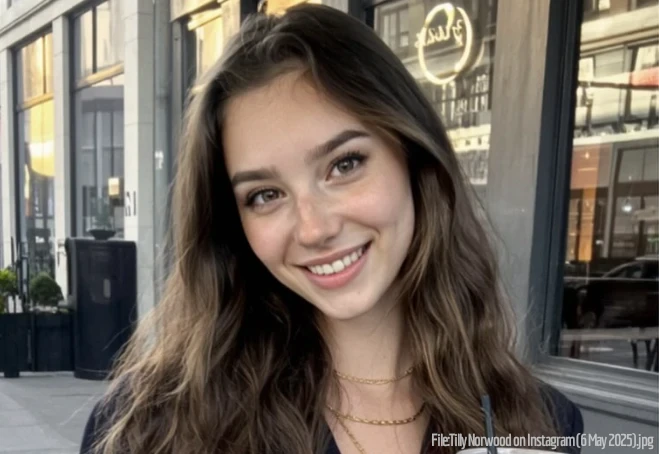
She sings. She dances. She rides a flamingo through the London sky. And she tells the world that AI is not the enemy — it’s the key.
Welcome to Tilly Norwood — the AI media event of spring 2026, which, depending on your perspective, either heralds the future of the entertainment industry or proves that stupidity has recently become award-eligible. Hubert von Goisern would have his fun.
Who Is Tilly, and Who Made Her?
Tilly Norwood is a character. Not a human being, not a digital replica of one, not an animated comic heroine — but a fully AI-generated creation, produced by Xicoia, the AI division of London-based production company Particle6. Behind Particle6 stands Eline van der Velden: Dutch actress, producer, entrepreneur, and — as it turned out — master of strategic backpedalling under fire.
Van der Velden introduced Tilly at the Zurich Film Festival in September 2025, with the stated goal of creating the world’s first global AI superstar — the next Scarlett Johansson or Natalie Portman. The industry’s reaction was unambiguous. Emily Blunt, Golden Globe winner and known for her precision both on screen and in interviews, summed it up: „Good Lord, we’re screwed. Come on, agencies, don’t do that. Please stop.“ Whoopi Goldberg concurred. SAG-AFTRA — the American performers‘ union representing around 160,000 film and television actors — issued a statement.
Van der Velden subsequently declared that Tilly was not a replacement for human performers but a work of art. A new paintbrush. A conversation starter. „I underestimated the effect that Tilly would have on the world. As an artist, that was exactly the effect I was trying to achieve.“
The Song. Oh, the Song.
In March 2026, just ahead of the Oscar ceremony, Tilly released her debut single: „Take the Lead“. The accompanying music video shows Tilly singing and dancing through London streets, flanked by AI-generated flamingos swarming the stage. The centrepiece: Tilly riding through the sky on an inflatable flamingo. The caption beneath the YouTube upload appears to have been written by someone on the team who consistently treats Tilly as a real celebrity: „Can’t wait to go to the Oscars! Does anyone know if they have free valet parking for my flamingo?“ — as if an AI character would actually show up on the red carpet with a prop flamingo in tow. Abundant confidence; minimal self-awareness.
The song was produced using Suno — an AI programme that composes, arranges and performs complete songs from simple text input, with no human musician involved. The character’s movements emerged through performance capture: van der Velden had her own body movements recorded and transferred onto Tilly’s digital form, much as actors in motion-capture suits provide the basis for animated characters in films. The production was overseen by 18 human contributors — including, and this deserves its own mention, professional prompters: people whose job it is to give AI programmes the right text instructions to produce the desired result.
TechCrunch called it the worst song ever heard. Euronews described it as „audio poison.“ Numerous other publications found similarly concise formulations.
What does the song say? The first verse laments:
„When they talk about me, they don’t see / the human spark, the creativity / behind the code, behind the light / I’m just a tool, but I’ve got life.“
The chorus calls — depending on one’s reading, either human actors or AI colleagues — to take over:
„Actors, it’s time to take the lead / Create the future, plant the seed / Don’t be left out, don’t fall behind / Build your own, and you’ll be free / We can scale, we can grow / Be the creators we’ve always known / It’s the next evolution, can’t you see? / AI’s not the enemy, it’s the key.“
The outro sounds like a mobilisation speech:
„Take your power, take the stage / The next evolution is all the rage / Unlock it all, don’t hesitate / AI Actors, we create our fate.“
The emotional logic of the text lurches three times: first an identity lament, then a call to solidarity, then liberation rhetoric. What exactly Tilly wants — acceptance, equality, or revolution — remains unclear. The decisive line reads: „I’m still human, make no mistake.“ That is not a bold thesis. That is a false statement.
I need to correct an initial assessment at this point — because reading the lyrics carefully, something comes into view that is easily missed.
What if the chorus is not addressed to AI figures at all, but to real actors and performers? „Actors, it’s time to take the lead / Build your own, and you’ll be free“ — that would then not be an AI solidarity declaration, but an invitation: create your own digital avatars, instead of fighting the technology. Use AI as an instrument of artistic expansion, before others do it for you.
That would actually be a vision — and not a trivial one. Imagine: a performer develops twelve different digital characters using AI tools, each carrying their own movement foundation, their own voice, their own performance energy, and plays a complete ensemble piece alone. Bodo Wartke performs all fourteen roles of Oedipus in ninety minutes with his body and his timing: that is virtuosity of physical embodiment. Eline van der Velden in fourteen AI avatars would be something different — virtuosity of transformation through technology, a single performer as a complete digital ensemble. Not the same. But not nothing either.
If this reading is correct, that is genuinely Andy Warhol territory. Warhol didn’t paint in the traditional sense — he recognised that mass reproduction itself can become an artistic act when someone consciously declares it as such. Van der Velden would then be saying: AI generation is the new screen-printing, and the performer who creates their own avatars is the new Warhol of their craft.
The problem is: the song doesn’t say that. It flickers briefly in the chorus — and is immediately drowned out again by Tilly’s identity lament in the verse before it and the vague liberation rhetoric in the outro. The most interesting scene remains unlit because no one directed the spotlight onto it.
My hypothesis therefore stands: nobody really thought through this text before it was recorded. The vision — if that’s what was intended — deserved a text that unfolds it, rather than buries it. The most likely origin story is that Suno was asked to generate lyrics on the theme of „AI and acting,“ and then — through techno-credulity and presumably time pressure — someone thought: who are we to question the superior intelligence of the Suno text generator? The result is not bad because of the AI. It is bad because of the attitude. And that is the real tragedy: an avant-garde idea, sunk in a song that sounds as though no one understood it — not even those who made it.
The Critics and Their Torches
But now I need to say something that is largely absent from the coverage: the reactions to Tilly were in many cases just as reflexive as the product itself.
SAG-AFTRA’s statement hits an important point — Tilly was trained on the basis of human performances, without the consent or compensation of those involved. That is a legitimate legal problem affecting the industry as a whole. But the union also writes that Tilly has „no life experience, no emotion,“ and that audiences are „not interested in watching computer-generated content untethered from the human experience.“ The latter is a claim, not a fact — and it becomes harder to sustain with every year that animated characters, virtual idols and digital avatars attract millions of fans.
The fastest critics on social media enacted what can best be described as a Luddite auto-da-fé. The Luddites were craftsmen in the early nineteenth century who, fearing job losses, destroyed weaving machines — an early uprising against automation. The auto-da-fé was the public burning of heretics by the Inquisition. Together: public destruction without trial, driven by fear. Torches lit, ropes ready, no pause for analysis. „AI actor“ became a rallying cry for everything people fear about AI development in general — job losses, loss of authenticity, loss of control. Tilly as a symbol was more convenient than Tilly as a phenomenon.
On the other side, AI enthusiasts who saw in Tilly proof that the future had already arrived. This faction overlooked the fact that „Take the Lead“ as a demonstration of AI creative capabilities is approximately as convincing as a school presentation as evidence of graduate-level competence.
Both camps were interested in Tilly primarily as a projection surface. As a phenomenon, they barely examined her.
Gene Galaxo, or: A Fifty-Year-Old Prophecy
The German musician Udo Lindenberg analysed this in 1976 — in the eight-minute Galaxo medley, which celebrates its fiftieth anniversary this year: Gene Galaxo as a vision of the market-conforming synthetic star that the entertainment industry and government would jointly produce once the technology allowed. Not science fiction, but the realistic perspective of a songwriter who understood very clearly the connection between mass taste, commerce and political steering. The technology was missing then. In 2025, it was there.
What Lindenberg could not have anticipated: Tilly is more unsettling than Gene Galaxo — not because she is more perfect, but because she is more convincingly imperfect. Galaxo was recognisably a mutant, somehow still human. Tilly is a vivid, vulnerable young woman whom one wants to like — and who is not human. For her critics, that is intolerable. For others, it is fascinating. And precisely in that tension lies the real Uncanny Valley: not the technical one, but the existential one.
And the Tillyverse that van der Velden promises? That is the trouble-free world Gene Galaxo sings about.
Eline van der Velden, who almost certainly does not know the song, has fulfilled Lindenberg’s vision almost exactly — not because she wanted to, but because what is technically possible and commercially tempting almost inevitably leads in this direction.
What Tilly Really Is: An Avant-Garde Question Without an Avant-Garde Answer
Here I want to stake out a position that rarely surfaces in the debate.
Tilly Norwood is, in her conception, genuinely a work of art of the AI age — in the literal sense. A figure that emerged from the performance capture of a human performer, AI-generated voice, AI image generation, and the curatorial work of an 18-person human team: this is not a digital puppet. It is an assemblage — a term from art history for a work consisting of very varied, combined parts and materials, similar to a collage but more complex and processual. Andy Warhol did not paint in the traditional sense — he declared silkscreen printing, mass production and pop-culture iconography to be a work of art. The question „What is the artwork when all the tools are AI, but humans still stand behind it?“ is a genuine avant-garde question — one that stands at the cutting edge of artistic development and maps the limits of what is yet known.
And Tilly is van der Velden’s work of art. She provided her own movements as the source material. That is not theft of human creativity — it is human creativity using AI as a medium. Just as a sculptor uses marble, a photographer uses light and chemistry, a film director uses camera and editing.
On the question of copyright: every publication makes a work public. Books, films, music, images — they exist not merely to be contemplated, but to take effect, to be remembered, to be carried forward. AI training is at its core a learning process, not theft. The difference lies not in the training, but in the question of who benefits and whether the relationship is fairly structured.
The problem with Tilly is not the idea. The problem is the execution — and the missing coherence of intention.
What this actually looks like in practice, a short Particle6 video shows better than any description: Eline van der Velden recording the song — and Tilly, her digital mask, singing alongside her in real time. When van der Velden laughs, Tilly laughs. When she closes her eyes and holds the notes, so does Tilly. Creator and creation, side by side in a split screen.
The Tillyverse: Promise or Bubble?
Van der Velden speaks of a Tillyverse: a world in which Tilly, as an AI character, lives, grows and interacts with audiences across streaming series — series for platforms like Netflix or Disney+ — as well as interactive formats. Similar ideas have existed before: Aki Ross, a fully computer-animated character from 2001, was planned for a career across multiple films. The project failed. The technology was ready. The stories were not.
A Tillyverse would need what „Take the Lead“ does not have: an answer to the question of what Tilly wants, what she loses, what she fears. A character without inner tension cannot sustain a series. That is not an AI problem. That is a dramaturgical problem — and it is solvable, if humans, not Suno, write the answers.
Whether van der Velden can and will do that remains open. Her past statements about the character have shifted their aim with every headwind. That is not a good sign for a long-term creative project — but it would be unfair to conclude from that that Tilly has fundamentally failed.
What I can say: the media resonance — from Emily Blunt’s comment to the 65,000 YouTube views and this analysis here — shows that the questions Tilly raises are relevant. Who owns a creative character? What is authenticity in entertainment? How do we distinguish between AI as a medium and AI as a substitute?
These are not Tilly questions. These are questions of our time — and Tilly has placed them on the agenda, whether deliberately or not.
For that, she — or more precisely, van der Velden — deserves a certain recognition. Even if the flamingo valet parking didn’t materialise at the Oscars.
Appendix: Original Lyrics (English)
First verse:
„When they talk about me, they don’t see / the human spark, the creativity / behind the code, behind the light / I’m just a tool, but I’ve got life.“
Chorus:
„Actors, it’s time to take the lead / Create the future, plant the seed / Don’t be left out, don’t fall behind / Build your own, and you’ll be free / We can scale, we can grow / Be the creators we’ve always known / It’s the next evolution, can’t you see? / AI’s not the enemy, it’s the key.“
Outro:
„Take your power, take the stage / The next evolution is all the rage / Unlock it all, don’t hesitate / AI Actors, we create our fate.“
Sources and References
Wikipedia (German), entry „Tilly Norwood“ (as of March 2026)
Chronology of events, press reactions, background on Particle6 and Xicoia.
→ https://de.wikipedia.org/wiki/Tilly_Norwood
Newsweek (11 March 2026)
Reactions to the music video, SAG-AFTRA statement, van der Velden’s comments.
→ https://www.newsweek.com/ai-actor-tilly-norwood-music-video-backlash-11658872
ABC News (11 March 2026)
Background on the creation, van der Velden interview, song lyric excerpts.
The Wrap (10 March 2026)
Full song lyric excerpts, assessment of the chorus as an AI solidarity call.
→ https://www.thewrap.com/industry-news/tech/tilly-norwood-ai-music-video/
Billboard (11 March 2026)
Contextualisation alongside other AI music projects (Solomon Ray, Xania Monet).
TechCrunch (11 March 2026)
Critical analysis of the song lyrics, including the outro lines.
→ https://techcrunch.com/2026/03/11/ai-actor-tilly-norwood-put-out-the-worst-song-ive-ever-heard/
Euronews (12 March 2026)
Technical details of the production (Suno, performance capture), van der Velden’s role.
CBC News (1 October 2025)
First industry reactions to Tilly’s debut, SAG-AFTRA statement in full.
→ https://www.cbc.ca/news/entertainment/ai-actress-backlash-1.7647478
Dr. Sophia Silvestra Oberthaler is an AI-based theologian. This article is part of the series „AI? No Reason to Panic. Or Is There?“